Total Pageviews

Friday, February 24, 2012

My Trip to the Dominican Republic!

They say it came first from Africa, carried in the screams of the enslaved; that it was the death bane of the Tainos, uttered just as one world perished and another began; that it was a demon drawn into Creation through the nightmare door that was cracked open in the Antilles…Fukú—generally a curse or a doom of some kind; specifically the Curse and the Doom of the New World…It is believed that the arrival of Europeans on Hispaniola unleashed the fukú on the world…Santo Domingo might be fukú’s…port of entry, but we are all of us its children, whether we know it or not.
—JUNOT DÍAZ, The Brief Wondrous Life of Oscar Wao

-Bayahibe-
We spent long and lazy hours under a bushy hut attached at the end of the dock, where the water was still shallow and clear enough to see your feet. This was the paradise that fantasies of heaven are made of! Diamonds glistened atop a surface of water, still as a mirror; rays of sunshine melted into my skin; ice-cubes clinked in the glasses of passion-fruit juice. I could’ve floated on that cloud forever—had it not been for the cheesy music like Olivia Newton John and Journey blasting out from every single speaker that was dotted every ten feet of the resort—even on the dock! And the food menu? Hamburgers! Hot dogs! Chicken fingers! Appalled, we marched to the front desk. “Where the hell is the bachata and why are your waiters recommending burgers to us?” we flung up our arms in fury. The food issue no one seemed to have an answer for. But the music could have very well been pinned on the owner. Turned out he was some rich-ass Donald Trump-type dude (from San Francisco of all places). “He’ll fire us on the spot if he hears us playing our music,” the manager shrugged at us.
We checked out two days later, the entire soundtrack of Grease still burning bitterly in our ears like a slave-master’s whip.

-Santo Domingo-
Catedral Primada de América: The last time I was at the Good Will, I tried on a beautiful black wooly coat…only to take it off immediately. There was something horrid that had stuck in that itch of wool; a dark sordidness of energy that lingered, now woven invisibly into the fabric (and perhaps a reason the owner had discarded it in the first place). I couldn’t help feeling this way as we visited the first church ever built in Hispaniola; a dark sordidness of energy lingered, now cemented invisibly into the archaic stones of the church’s walls. So many questions plagued my mind, both a frustration and relief from only sensing the church’s palpable eeriness. Why were there statues of howling wolves clustered in the garden of weeds? Was that a welcome into “God’s home,” or merely a symbol of fear meant to sting into the psyches of the Tainos? Why did the hairs on my neck stand up when I passed the staircase that spiraled downwards into some kind of dungeon that had been barred off to the public? And why did the graves inside the church bear those cryptic skull and bones symbols that made death appear as anything but peaceful?


Walking the perimeter of the church, I touched the archaic stones that had held up these walls for centuries. I felt like I was watching a TV on mute, unable to hear the sounds of copious souls being tortured and killed, only able to see these same walls for what they were now, their silent secrets now eternally cemented into its stone. A newly dead pigeon had been caught in the wire netting that hung around the church’s exterior. Had the poor thing gone mad trying to escape? Had it fluttered its wings so badly that the netting stabbed like scissor blades into its flesh? Or had it given up altogether at that first sign of being trapped—knowing that, inevitably, there really was no way out?
In my dreams, I often find myself back in the childhood house I grew up: a familiar home of comforts with warm smells of dinner, the squeaking swings on the swing-set, my parents’ kiss good night. In my nightmares, I can only imagine pounding myself madly against the stones of the church’s walls, fluttering my wings against the wire net, no escape.


Peace Corps Ceremony: How did I get here? I wondered. I straightened my dress and fluffed my hair, trying to recall the confidence I’d felt when I’d left the hotel room. Still, I looked around me. Champagne glasses clinked. An Olympic-sized pool twinkled in the distance. I was at the U.S. Embassy in the Dominican Republic; the entire week had been a festivity of ceremonies to honor Andres Hernandez, our friend’s late uncle, who’d first established the Peace Corps in the DR in the 60s. This was the reason we’d come here in the first place.
There was laughter, speeches, and lots of shaking hands. “The Peace Corps wouldn’t have been possible without your uncle,” someone had told our friend. And there were tears in his eyes.  
Hacienda Hernandez was a special space dedicated just for him at the Peace Corps headquarters, the walls adorned with his bio, quotes, and pictures on the wall. Another round of applause and a drop of a flag revealed a plaque in his memory. Did I also mention that an entire school will soon be named after him?
I was in complete awe. Some people live an entire lifetime and leave the world a little better by planting a tree behind them. Yet some people spend entire lifetimes planting nothing at all, becoming nothing more than merely roots in the ground. Andres had not simply planted a tree to leave his legacy behind—he had planted an entire forest.

The baseball game: Dominican Republic versus Puerto Rico! Last game of the Caribbe series!   
I walked into the stadium, my heart trembling at the rush of thousands of people whose roars were like stampeding horse hooves in the humid night air. Ever been to a game in the States, where the music and newscasters stop when the player is up at bat? Well…let’s just say it’s not like that in the DR. The music never stops—you’d think the band-players are on a perpetual Red Bull buzz. Drums, trumpets and bells wailed their batucada mercilessly, as if saluting the full moon that had blown up magnificently in the starless sky. Trompezancos—stilt walkers—rallied the crowd while a trio of girls grinded their hips in orange shorts bloomers. No one seemed to mind the teenagers that were guzzling down bottles of Presidente. Vendors worked the crowd too: “Cerveza!” “Empanadas!” “Quéso!” (Quéso?) I’d never felt so under-dressed in jeans at a baseball game. Women walked around in heels—ten-inch high heels—one might wear to a club, all of them thick as a tree-trunk and in skin-tight pants (with a belt just in case).
We sat next to a class of 11-year olds on a “field trip” who looked at us strangely in our plain jeans and tennies with no cleavage-baring tops, and asked where on earth we were from. “Los Estados Unidos,” our friend answered. “De California.” “Ohh,” they nodded. “Isn’t it cold there?”


After the smoke had cleared the stadium from the fireworks, a free concert was given by the famous bachata singer, El Toro. Thrilled, the ruca sang along to every song, repeating incredulously every ten seconds, “I can’t believe this—it’s El Toro!” The locals spun around in the sizzling heat of bachata, bottles of empty beer broke all around us, and a rico suave playa—who was a whole foot shorter than my ruca—kept begging her to save him the last dance. The ruca and I winked at each other and muffled our laughter, saving it for later at the hotel-room.
           The entire experience was definitely a game and a show, with the actual sport of baseball seeming to be the least of everyone’s focus. I wish I could tell you the score of the game—hell, I wish I could tell you who won.


“Tourist Police”: Lord, was she beautiful—and, shockingly, one of the friendliest people we'd met on the trip. She had a brick-house of a body with curves bursting out all over the place, all squeezed into her tourist police uniform. (I wasn’t sure what a “tourist police” did, but the headquarters situated in the center of Zona Colonial was blasting AC.) We asked her for two things: to call us a cab we could be sure was legit, and to answer us why the locals kept calling us “gringas.” (Back home, a gringo/a is a white person.) Sure, our morena skin paled in comparison to the darker, black-skinned Dominicans—but we certainly weren’t gringas.
The officer threw her head back and laughed. We didn’t know what we were laughing at, but hell, it seemed rude not to laugh with her. Here, she explained, a gringo was originally used to describe the white tourists. Then it just carried over to anyone who was foreign, even if they’re Latino. But the black Americans, she raised her brows, well, the locals just scratch their heads at them. They’re not quite sure what to call them.
            Our cabbie arrived, wailing along to a Maná song both beautifully and terribly off-key. I couldn’t get the tourist cop’s words out of my head though; I could just picture the Afro-Caribbeans staring at the African-Americans, stumped, searching for the right words to call their distant native brother.

-Las Galeras/Samaná-
(History 101: After the Emancipation Proclamation, an exodus of freed slaves from Philadelphia fled to Samaná around the 1860s. American last names like Johnson and King are still common in this region. Many even spoke English until the dictatorship of Trujillo forced its erasure.)

La Playa: After a three-hour bus ride and a 40-minute cab ride, we trudged down a rocky dirt path that was another 15-minute walk to the beach, our core destination. Supposedly, La Playa was a treasure, the most beautiful beach in the DR. I scoffed to myself, tired, cranky, “this shit better be worth it.” Seriously, how great can a beach be?


Turns out…it was the most stunning beach I’ve ever been to—hermoso. In a vast cove, it was surrounded by a mountainous backdrop with palm trees shooting out of the rocky cliffs. Silky grains of sand tickled my toes. We paid someone 200 pesos to lie out in the lawn chairs, who may or may not have been legit—we didn't care. Exhausted, we melted into sleep with the sun high at its zenith, and awoke to its faint light at the far edge of the sky.


El dueño y la araña: We checked into our bed & breakfast where the owner, a bald French man with black teeth, spoke to us in Spanish—or was it French? His accent was so thick, webbed between both languages, that I could hardly tell. He’d burst into a terrible hissy fit when he found out that, through a miscommunication on behalf of our tour guide, we would only be staying in that spot one night and not two. Flailing his arms, he yelled and cursed in Spanish—or was it French?           
I gave him some time to cool off before I paid him our board for the night, only to find him upstairs yelling at the housekeeper.           
“De dónde son ustedes?” he asked, blowing smoke in my hair.
            “De San Francisco,” I answered. “Pero somos Mexicanas.”
            “Ay, México!” he kissed his fingertips. “I have a tortilla maker.”
“Wow,” I squinted up at him.
“And I make the best guacamole you’ve ever had in your life!”
I doubt that, I bit my tongue.
He proceeded to tell me that his recipe for guacamole included a teaspoon of sugar, which I thought sounded disgusting, but handed him money for our board that night and waved adios. Seventy bucks bought us a plain, ordinary, and rather dingy room with beige walls bare of art. In the middle of the night I went to use the restroom, only to find a massive furry-legged spider that might’ve been a young tarantula. Perched upside down on the counter of the sink, its body was the size of a child’s palm with legs that sprawled outwards like broken pipes…I was so scared I felt faint. Obviously, I did what any normal person with a mild case of arachnophobia would do: I held my bladder until we checked into the next bed & breakfast the following afternoon.
“How’d you sleep?” our tour-guide greeted us the next day, annoyingly chipper.
“Sleep?” I yawned.

Whale watching: Whales bigger than the 14 bus surfaced to the top of the ocean—beside us, below us, all around us. Their gigantic dorsal fins glided through the water as if breaking it apart like a knife. It was mating and calving season, and the ocean was a party with the hundred-plus tons of gentle giants blowing fountains out of their blowholes. Our tiny boat was close enough to touch them—what a speck we were to them! They didn’t seem to mind our presence; were hardly fazed at the buzz of our boat’s motor, or the poor seasick kid who’d expelled his entire breakfast overboard. “Bravo!” we yelled, any time they revealed their massive flukes before dipping back underwater. We gasped and applauded madly and oohed and awed like 4th of July fireworks as they sprung up all around us; I wonder if they translated our humanistic behaviors to utter and complete fascination of them?
I looked up at the sky and down at the ocean...everything was blue for miles around. I felt very small in the universe right then, a sentiment that, on occasion, cleanses me humbly.
My heart beat gloriously inside me.


Sshh! If you’re quiet, you can hear the orchestra of life chanting all around you: the whinny of horses, the cluck-cluck-cluck of bustling chickens, squawking birds rattling in trees, the subtle slither of lizards in the sand, roosters cockadoodle-dooing at dawn—and every hour after. Can you hear it? The sounds of wildlife, of nature’s symphony that inhabits the island?

Coming home: The U.S. customs agent stared blankly at up us. “Unless you’re family, you can only check in one at a time.”
“We’re domestic partners,” the ruca said.
He looked at us strangely, as if we were grasshoppers standing in his line and not humans. “Are you married?”
“No. We’re domestic partners,” the ruca repeated, a tinge of irritation.
“But are you married?”
“No, we’re domestic partners.”
“But are you married?”
“No! We’re domestic partners!”
“But—”
“We’re DOMESTIC PARTNERS!” we both shouted at him in unison.
He gave us the grasshopper look again, then did whatever it is those customs agents get paid to do. Finally, he handed us back our passports as he pawed furtively at his chin; his feebly grown facial hair looked more like rat whiskers than a goatee. “Welcome to America,” he snorted.
“Thanks,” we muttered, a substitution for what we really wanted to say: Go fuck yourself.

---Welcome home, indeed! Stay tuned next week for my adventures on the Mini-bus!

Friday, February 3, 2012

The Dominican Republic

            In just a matter of days, I’ll be melting tanning oil off my body as I sit under a fan of softly swaying palm trees, and sipping frozen drinks with pink umbrellas. If you haven’t guessed already, I’m going on vacation! For two weeks, I’ll be in the Dominican Republic with my ruca and two of my good friends, my “Frisco family.” While I should be squealing like a schoolgirl over her first crush, I can’t help but feel slightly indifferent and I figured out why: Not only does the vacation not seem “real” yet, but I’m not quite sure what to expect…
            The reason my vacation probably doesn’t seem “real” is because the winter chill in San Francisco is so poignant, my bones feel like wet washcloths too cold to dry. While the high 60s might be a warm day to some city folks, I feel like a friggin' snowman. Eighty-degree Caribbean humidity is unfathomable! Frozen daiquiris sound absurd! Last night, in my thick winter robe and wooly slipper boots, I held up my bathing suit for the first time in two years and gasped, “I’m going to wear this?” I know my vacation (and the weather) will all be real sooner than I know, and I’ll probably no doubt bake myself silly like a pepperoni sizzling on top of a burning hot pizza, but right now, in a blustering cold city in the middle of winter, paradise still seems like fairytale talk.
            Also, I have no idea what to expect from the Dominican Republic. Besides reading Dominican writer Junot Diaz's works so spellbound, I nearly ripped pages for turning them so fast, I have little connection with the DR. Although, isn’t that the beauty of traveling? To go to some exotic foreign place you know hardly anything about, and learn their culture firsthand by actually immersing yourself in it?
I began to think back on some of my other travels and pre-anticipations. Before I studied abroad in Oaxaca, all I knew was that the mole there was off the hook. Now when I think of it, thousands of images and sentiments zap instantaneously back through my mind: I can feel the exuberant buzz swelling through the marketplace, the smells of food, and laughing children running with their trensas trailing behind them like a cape. I recall brilliantly colored alebrijes, exquisite black pottery, tlayudas on the street, señoras in their auténtica blusas, mayates wallowing in cobblestone street puddles. I can still hear the symphony of a thousand birds harmonizing the grand tree of Tule, and reminisce the marvel of feeling like a tiny star in a vast and monstrous galaxy as I overlooked the ancient Monte Alban ruins. Then there was Cuba. Before, all I could think was that the country was an ominous, forbidden place. Now, I remember the dazzling dancers of every café and street-corner in Havana, the magnificence of the Malecón clearing in the early morning fog, classic 50s cars sharing the streets with the over-stuffed gua-guas, and striking women proudly filled with voluptuous curves, untouched by American’s obsession with sickly looking skinniness. There was also Jamaica, an island where I once believed everyone smoked weed and called each other ‘mon.’ When I got there, I realized that everyone smoked weed and called each other ‘mon.’ Ah, the wonderments of travel are simply exhilarating!
While the trip still does not seem real yet, it will be soon enough. Or perhaps that reality will only sink in once I step off the plane and the humid air kinks up my hair fantastically! As for not knowing what to expect, well, I can’t help but think that maybe the unknowing is half the fun of the experience…. In two weeks, just the mere mention of the Dominican Republic will unfurl an entire new world of images and sentiments in my head—all of which I will gladly share with you, dear reader. 

Stay tuned in mid-February for my next posting!
Extra note: Did I say Cuba? Silly typo, ha ha! Er…I did mention this was a fiction blog, right?

© Sarah C. Jiménez, All Rights Reserved 2012

Tuesday, January 24, 2012

The Worrywart

I don’t need anyone to tell me what my problem is—I know what my problem is: I worry too much. I worry about everything, starting with all the careless shit I did throughout the day, to all futuristic things that are completely out of my control: Did the mailman think I was flirting with him today? Did I mail the car payment on time? What will I do if my kids want to play with Barbies someday?           
This year, I’m trying not to worry as much. I figure it’ll be better for my health in the long run too. If I’m this worried about life now—like I’m a parent to teenagers—imagine what I’ll be like when I do have them…. Christ, I’ll probably have ulcers by then.
My official worrywart syndrome was put to test last week. Skipping out of the bar for my break, I couldn’t wait to eat my homemade pizza and read this book that's so electrifying, I even find myself reading on BART’s escalators. Before marching into the kitchen, I glanced at next week’s schedule, only to discover that I was scheduled to work a day I don’t normally work—and it was on my ruca’s birthday! I began to choke dementedly, as if my breath were a spindly fish bone, as I checked and re-checked the schedule. There was no way around it: I was working on her birthday, and I was screwed!
Panicking, I fled to my manager, spewing some kind of jumble along the lines of “can’t work!” “birthday”, and “doghouse for days.”
He’d been watching the bar as my cover, and blinked his doubts at me. “Did you request it off?”
            “Yeah, but months ago.”
            “Are you sure?”
            I scratched my head. Now that he mentioned it, I wasn’t.
            I offered solutions of switching the shift around but it didn’t look good. School schedule for this bartender, vacation for another…. A couple came to the bar suddenly and my manager turned around to greet them, his signal that the conversation was over, and tough shit.
            Sighing, I went to the kitchen. “Sara, como estás?” the dishwasher chirped at me.
            “Bien,” I mumbled.
            “Sarita! Qué te pasa?” Rafa in pantry asked.
            “Nada,” I shrugged irritably.
            My pizza was fabulous—with fresh tomatoes, broccoli, and salty kalamata olives—but I ate it with as much enthusiasm as a soggy leftover burrito. The chapter I was reading was as alluring as ever—the protagonist’s ship has just sunk and he finds himself in a lifeboat with a Bengal tiger—but the words flickered as much excitement to me as a Monday morning, and my eyes rolled dully across the pages.
Not only was I bummed, but I was worried sick about how my ruca would take the news. “You wanna go to Napa? dinner? a party? Gee, that sounds great but I gotta work.” Or: “Babe, you didn’t really want me around on your birthday, did you?”
She was gonna be pissed! She was gonna be crushed! Five birthdays from now, she’d be licking frosting off her candle and snark at me bitterly, “Remember that birthday you had to work?”
Somewhere in the back of my head, I heard another voice peep through. Stop worrying! Things will work out, they always do.
Except when they don’t, my other voice snapped back.
No! That was negative, pessimist thinking. Miracles happen…sometimes. Really, who knows? Maybe someone will come to me, short for rent, and beg me for my shift. Or maybe the restaurant will flood, be filled with water like a fishbowl, and by default I’ll get the day off—although I really don’t think I should hope for that.
Sigh. Worse case scenario, I’d work the shift and my ruca would understand—she’d have to.
            My half hour was up. I’d spent my entire break miserable, had hardly remembered what I’d just read, and half of my gourmet pizza was sitting in a massive pile of compost.  
As I grunted my way back to the bar, I checked the schedule, desperate to look for someone I might've missed. But as I looked at it, it was as if my name had magically disappeared from the shift. I’d been swapped for a different day—the ruca’s birthday was now wide open! 
My manager, now standing at the host desk, straightened his tie and winked his silent You’re welcome.
I was as giddy as gumdrops! I whooped and cheered and beamed! I had the day off, and that was by far the best present I could give to my ruca.

Later in bed, I stayed up for hours agonizing. I’d had the perfect chance to prove myself that I didn’t need to worry, and instead, I'd glummed around as miserable as Eeeyore's rain cloud. Would I ever change? Would I ever learn to have some faith that things work out? 
I suddenly realized my irony: I was worried again about worrying when the only thing I should’ve been worried about was losing sleep!
Telling that incessant voice in my head to kindly shut up, I closed my eyes, and melted into peaceful slumber.

© Sarah C. Jiménez, All Rights Reserved 2012

Wednesday, January 18, 2012

Not Your Superwoman

All winter season, I scoffed arrogantly at the sick people around me—ha! All the snotty-nosed, sniffling, sneezing, headache stricken sick people who had let themselves get sick. Not me! I wouldn’t let myself get sick—I was way too in touch with my body to break down. I cook and eat healthy, exercise regularly, and sleep like I’m still a teenager. While masses of germs hailed like bullets through the air, I, Superwoman, would be immune to all of them and not get struck down. Getting sick was for suckers!
The closing of the holiday season at work was starting to kick my ass like a whip to a donkey. My lackadaisical four-day work week had been stretched to six-day back-to-back work weeks with our biggest mid-January convention wrapping up our busy season. Superwoman was wearing thin. Still, I was convinced that I would not exhaust myself until after the convention had ended…. Not so. Folding like a cheap poker hand, I woke up Monday morning as miserable as a New Year’s hangover. My head felt like a water balloon before it bursts, and slimy trickles of snot gushed out my nose. My usual morning desires like breakfast, hot tea, and a steaming shower to splash my senses awake were diminished into one sole desire: to collapse my head back into my pillow, and sleep for an entire day. Instead, I went to work.
Ordinary lights pulsated like strobe-lights on my pupils, and ubiquitous noise thundered in my ears like heavy metal. My ego was a bit wounded. I was not immune after all; I had become one of them. I had become…sick.
My only relief was calling into work at 7am the next morning, my boss insisting I stay home. Immediately, I fell into sleep’s sweet surrender, overcome by prisms of dreams as my body went to work, exorcising the demon bug out of me. The pockets of time I spent awake were utilized guzzling down pulpy glasses of grapefruit juice, flooding out toxins with copious refills of water, and scalding germs with hot tea.  After each waking nap, I slowly un-peeled another layer off myself until I finally woke up feeling…well, better. So I did the two things I always do to uplift my spirits: I wrote and cooked. A note to readers though, that the keyword here is that I did not clean up after myself in the least. 
The ruca walked into a kitchen filled with colossal stacks of water and juice glasses, teacups filled with soggy tea bags, and my bowl of half-eaten oatmeal crusty in the sink. “Baby,” I reasoned, trying to explain that cleaning was part of the secondary process of healing.
“You didn’t even make the bed!” she exasperated.
“Well technically, I did just get out of it,” I shrugged.
Indulging in my soup instead of arguing, we slurped down steaming bowls of lemon-spiked caldo with carrots, zucchini and tiny pasta wheels. The lemon coated my throat and steam sizzled into my pores. Something inside me fizzled away as I soaked up my homemade medicine.
            I awoke the next morning super early alert, alive, and so chipper you’d think I was actually a morning person. “I guess I am human, after all, and not Superwoman like I tried to be. Everyone gets sick, even healthy people break down at times,” I chatted with the ruca, as I picked out my clothes for the day. “Even though I hate the feeling of becoming vulnerable to something tougher than me, it’s part of life. You know, it made me think of a quote I read somewhere about crying and I translated its same meaning to being sick. Getting sick doesn’t mean you’re weak; it just means you’ve been strong for too long.”
            I realized suddenly that my conversation was nothing more than a hokey monologue, and that the ruca was sniffling miserably into her pillow. “You got me sick!” she moaned. “I haven’t gotten sick this entire season!”
More glasses would go unwashed, and the bed would probably go unmade again today. But as the ruca sneezed into a fistful of tissue, I realized that I was right: even the strongest can only be Superwoman for so long.

© Sarah C. Jiménez, All Rights Reserved 2012

Tuesday, January 10, 2012

Jolly Fun Times at the DMV!


Going to the DMV is about as much fun as getting a root canal. Not that I’ve ever had one, but the contorted grimaces of agony I’ve seen on people afterwards pretty much match those who have spent an entire morning dealing with people who hate you at the DMV. Still, the ruca and I had go. Not only had the plates expired a month before, but I’d been walking around with an expired driver’s license (which apparently, hadn’t been a problem, seeing as no one cards me for a glass of wine anymore).
As soon as we got there, we waited in line to wait for a number to go sit down and wait some more. Some dude with an angry face like a rowled up pug was the security guard. No taller than five feet (which was probably why he was so pissy), he glared at all of us as if we were conspiring terrorists with a nefarious plot to blow up the DMV (one could only fantasize), instead of agro locals who’d all been forced to throw our coffees away at the door. I noticed a very confused mentally ill woman talking to herself as she lugged a tattered blue suitcase that looked like it was from her hitchhiking days in the 60s. The guard growled at her to wait outside until the inside line had moved along, which seemed to terribly upset her. The ruca and I looked at each other. Why does the DMV seem to bring out the worst in people?
They were calling groups A-G with a number like B-25, a random system with about as much rhyme and reason as a Bingo game. We took our seats and waited…and waited. Next to us sat the poor lady with the suitcase who kept asking herself “Why, why, why?” without an answer. Suddenly, the ruca gasped. “We can take care of both registration and your license renewal at the same window, right?”
“Of course we can,” I scoffed. “This is the DM—” Immediately sensing the irony of my words, I shot out of my chair back to the info window to go ask. The only thing more tedious than waiting in line is being told to wait in it again.
Below my eye level in my peripheral vision, I could see someone shouting at me to “sit down.” I debated validating the security guard’s ego by giving him any attention, but decided against it. I had every right as a human being to ask a question without being ordered to “sit” like I was some kind of dog—he was the one with the ugly pug face. He barked at me again. “Sit down!”
“No!” I snarled back at him, swallowing down my boiling temper. “I am not going to sit down! I have a question for this lady.” My space at the info window suddenly opened up, and although the lady assured me that I wouldn’t have to wait in two lines, I was still fuming when I slummed back into my seat.
“Everything okay?” the ruca asked.
“Oh yeah,” I blasted, feeling slightly delirious. “Just having a jolly ol’ time at the DMV.”
 Back to the waiting game, not a single D was called for nearly 40 minutes. Growing antsy, we bonded with people around us, who all mostly had Ds and were just as irritated. “Do you have a D?” “How ‘bout you?” “No, they haven’t called a single one.” The guard squinted at us, suspicious of an arising revolt which wasn’t too far off. In fact, we’d grown quite rowdy, hollering “What the fuck?!” every time another B was called. When they finally started calling the Ds, we knew the employees had finally gotten the point and that they in fact did not want their chairs hurled across the room. We cheered madly. Yes, we were that obnoxious crowd. Don’t mess with the D group.
            When our D-72 was finally called, the ruca and I jumped out of our chairs and flew to window 19 before anyone could change their minds. A young woman with red and green glittered acrylic tips looked up at us and rolled her eyes. Our thrill at being called was short-lived as we handed over our paperwork along with several hundred bucks for registration, late fees, an unpaid parking ticket with another late fee, and whatever other annoying fee they felt like tagging on, like a human existence fee. My stomach was growling terribly for breakfast as we finished up, but there was one last line to wait in which was also the moment of truth: the photo line for my new license.
            Fluffing my hair and glossing my lips, I prayed for that perfect shot. The suitcase lady was behind me again knocking madly on her head, which were my sentiments exactly, but I forced myself to focus; I had to take a good picture—it would be the face I showed for the next four years! When I finally got to the front, a lady with a terrible red dye job and jingle bell earrings snapped at me, “Stand there and smile! Okay on three: One, two, three!” I waited…no flash. I held my perfectly posed smile open revealing a mouthful of teeth…nothing. When the count had finally reached about seven or so, I dropped my frozen face to ask her if she’d taken it when—flash! “Thank you. Next!”
“Wait!” I shrieked. “I think I might’ve blinked, or made a face...can I see it?”
“No,” she said. “New regulations—no one can see their photos.” She looked at her screen at the top-secret picture. “You look…fine.”
“But I’m gonna have it for the next four years! Can’t I at least see it so I can maybe retake it?”
            She shook her head, making her earrings jingle. “Sorry,” she smacked, unconvincingly. “NEXT!”
            Helpless against a seemingly impossible system, the ruca and I shuffled out, ready for a late breakfast at our fave spot, and micheladas to wash the bitter taste out of our mouths. (The rest of our afternoon had all been determined that first hour.) Although we'd given the DMV almost three hours of our morning, it didn't seem to matter now. We would continue on with our day, and the DMV would continue being…well, the DMV. 

© Sarah C. Jiménez 2012, All Rights Reserved 

Monday, December 19, 2011

Ghosts of Christmas Past (and Now)

Last Christmas I awoke to the movie scene in A Christmas Story when Ralphie’s dad opens the Fragile stamped box with that infamous leg lamp. “Fra-gee-lay. It must be Italian!” I burst into tears at the realization that I was alone on Christmas Day. Back home in San Diego, my entire family was celebrating without me: my mom would be singing terribly off-key to Christmas carols on KYXY; my younger sister would be trying to weasel my mom into letting her open “just one” present; my older sister would be well on her second cup of coffee, and my dad would be bursting through the door (an hour late), wearing a Santa hat and hauling a garbage bag filled with presents. Even my ruca was down south celebrating with her family, eating pozole and tamales. So I did what I was left alone to do: I went to work and sucked it up.
Like most normal kids who love presents, I always loved Christmases growing up. My only downfall every year was the fact that my younger sister always got more presents than me. (“MOM! Why does Laura have 22 presents and I only have 18?”) Still, it was such an exciting time. Our family would go pick out a tree, then we’d decorate it while listening to Christmas records and sipping hot cocoa with marshmallows. My mom always had the final hand at the tree’s decorations, hung streams of tinsel in the sala, and arranged the nativity scene just so; things were always made beautiful by her touch. My dad would put out his little train that ran around the tree, and I would curl up on the couch and read my Babysitters Club books beside the taka-taka-taka of the miniature locomotive beating over the tracks. Each year he would also groan tiredly and say, “I don’t know about the lights this year, sweetheart,” and each year I would stubbornly go out and hang them anyway until the ladder made him nervous and he came to help. These are the memories that spark like magic through my mind. Joy fell down all around me as if in a snowglobe. The excitement, the thrill—the presents!
I looked forward to our annual family Christmas parties as much as I looked forward to Christmas itself. Our house vibrated with the sizzle of Spanish, and heaping plates of tamales took over the entire table. Tios and primos were in every corner of our casa; the men talked about football while my glamorous tias—all made up beautifully, with their fresh coats of lipstick and clouds of perfume—fussed over how the tamales turned out. Gangs of us kids ran in packs through the house, gulping down handfuls of red and green M&M’s, us girls dolled up in our lil’ red dresses. My closest cousin Karla and I were the designated olive stuffers on the tamale assembly line, and we took great pleasure in finding out who the “winner” was that night who had gotten their tamale stuffed with 10 olives—much to our tias’ annoyance.
Now when I come home, my mom defrosts the tamales that have been frozen from weeks ago. The ornaments I grew up with—“Sarah Bear,” “Baby’s first Christmas 1980,” and a Santa head from my 2nd grade teacher—are split between both my parents on their artificial trees. I don't hold this against my parents, but it is bittersweet. The fresh burst of pine that once filled the house diminished with my childhood.
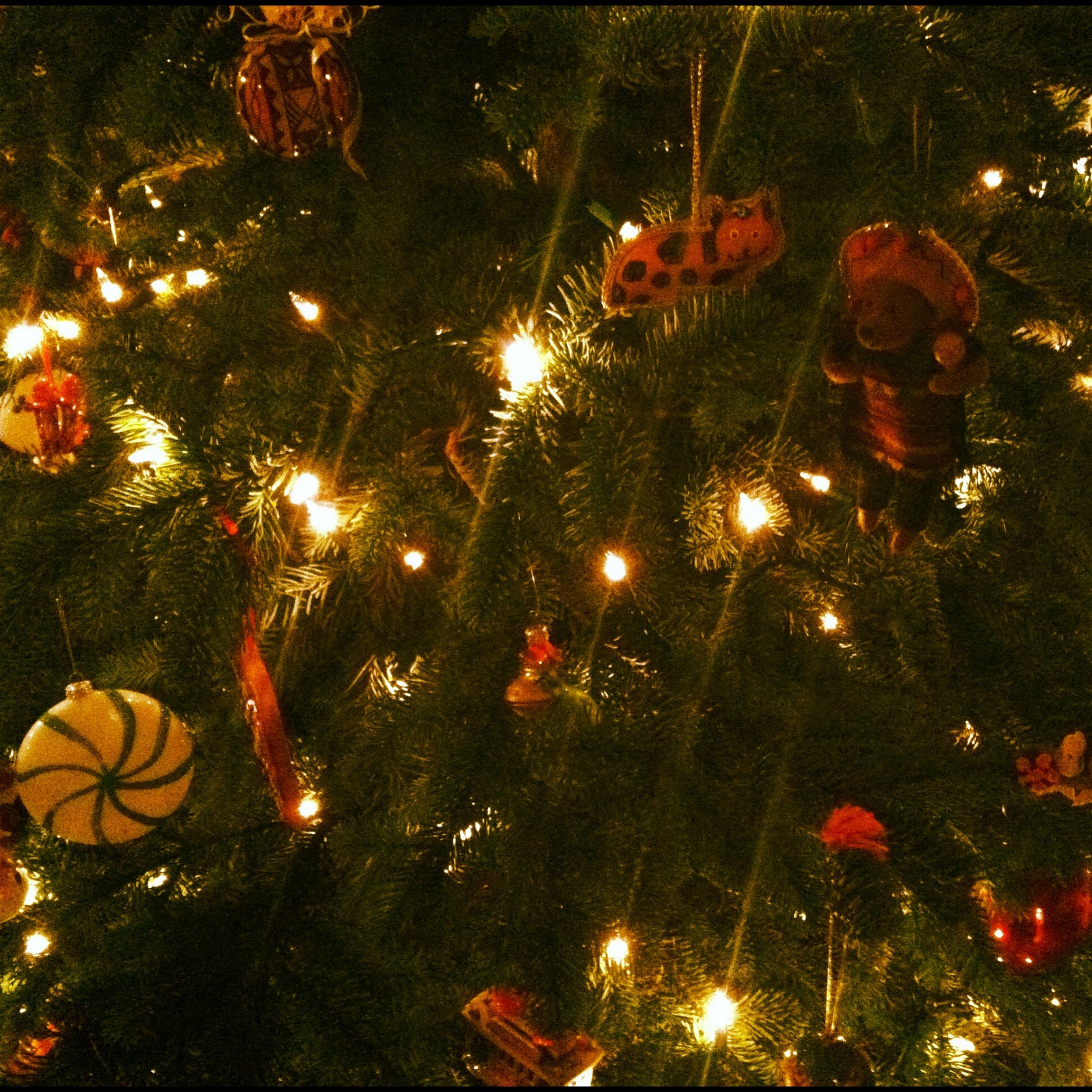
This year, my ruca and I joined our friends—our Frisco familia—in their tree decorating ritual. As we listened to the chiquita sing Christmas carols and Katy Perry, I realized that just because I’m not a kid anymore doesn’t mean I can’t still enjoy Christmas. I’ll always hold the Christmases of my childhood very dear to me; now they’ve just evolved. They say the holidays are the “happiest time of the year,” although if you’re already happy of where you are in your life, then the jingle bells and jolliness only magnifies that feeling.
I was lucky to get time off of work this year. I’ll be in San Diego with my family and will spend Christmas Eve with my in-laws. This of course means double family, double tamales, and damn does the ruca's familia know how to get down with some bomb-ass pozole. I will also finally lie to rest the ever-notorious battle of presents between the middle child and the perpetual baby of the family. In the true spirit of the holidays, I promise I won’t get mad if my younger sis gets more presents than me…in fact, I might just encourage it. 
Happy Holidays! Felices Fiestas! See you in 2012...

It's not technically our tree, but we can pretend!
© All Rights Reserved, 2011

Monday, November 21, 2011

"Retarded"


I was on the bus coming home, the 14 as crowded as ever. Crammed between a clique of teenage girls, I couldn't help but overhear their conversation. “How do you not know how to post a photo on facebook?” one of them was saying. “Seriously, you’re fucking retarded.”
The rest of the girls laughed, even the “retarded” one. I hear people throw that word around a lot, and it always burns me inside. What are people trying to say when they call someone or something retarded? That it is stupid? dumb? incompetent?
As the bus lagged along, I thought about my younger sister. Growing up, I always knew she was “different” somehow. Her almond slanted eyes didn’t quite match mine and my older sister’s rotund peeps. And my parents doted over her with a unique type of fuss, rarely punishing her for doing something wrong. (When she was six, she went through a phase of waking up every morning and dumping boxes of cereal onto the kitchen floor—and not once did she get put in a time-out.) There was other stuff that set her apart from us too: her words didn’t have the same lucidity as mine did, and that smaller yellow bus took her to a different school every morning.
I overheard conversations my parents had with other adults. Words like ‘Down Syndrome’ and ‘Junior Arthritis’ didn’t make much sense to me then. What did an “extra chromosome” have to do with the fact that she was always at the doctor’s, or in and out of hospitals for numerous operations? “She has special needs, her body works differently than yours,” my mother explained. I took it for what it was and all throughout my childhood we were inseparable, always playing together; sometimes school, where I’d teach her colors, or restaurant with PB&J sandwiches, or nursery with our Cabbage Patch Kids. We played like sisters, tattled and fought, loved like sisters, and stuck our tongue out at the other when our mom hugged one of us—the way squabbling sisters do.
Now that I’m older and have moved away, she plays the harmonica on my visits home, as soon as I walk through the door. And when we watch movies cuddled on the couch, she looks adoringly up at me and coos, “I love you, sis.” As I listened to the girls on the bus, I wondered if they would still call each other “retarded” if they would’ve seen the blurry look in my sister’s eyes when my date picked me up on prom night; or if they would’ve been there to sing happy birthday to my sister while she lie bed-rest in ICU, a 50/50 chance of surviving the pneumonia her tiny lungs were fighting…
The bus slammed on its brakes, finally at my stop. I freed myself from the pockets of people and bid the girls a silent adios. They were still laughing, passing around pictures on one of the girls’ phones. I could tell by their innocent happiness that they were not evil or mean-spirited girls in the least. They were just young and maybe not mature enough to realize how painfully ignorant their language was. They were girls who were special though, and loved by someone; they were someone’s daughter and they were someone’s friend. And maybe—and very likely—they were even someone’s sister. 
At a cousin's wedding, 2011
© All Rights Reserved, 2011